2024

Transforming Fundraiser Prospecting with AI-Powered Search

Transforming Fundraiser Prospecting with AI-Powered Search

Replaced manual filtering with an AI-driven prospecting system, enabling fundraisers to identify high-value donors faster and with greater precision.

DELIVERABLES

Designs

Working Prototype

Spec

ROLE

Product Designer II

Interaction Model

System Design

CONTEXT

Q1 2024

Initial AI Product Initiative

Campaign Team

RESULTS

Impact on search behavior and donor discovery

+17 NPS (27 → 44)

+17 NPS (27 → 44)

Improved user satisfaction and trust in search results

Improved user satisfaction and trust in search results

30% Faster Discovery

30% Faster Discovery

Reduced steps from multi-filter workflows to single-query results

Reduced steps from multi-filter workflows to single-query results

3x Faster Query Completion

3x Faster Query Completion

Users moved from multi-step filtering to single input + result

Users moved from multi-step filtering to single input + result

70% Adoption Rate

70% Adoption Rate

Shift from legacy filtering to AI-driven search

Shift from legacy filtering to AI-driven search

THE PROBLEM

Donor discovery was slow, manual, and unreliable

Fundraisers relied on complex, filter-based workflows to identify and prioritize donors. These workflows required multiple inputs and iterations, producing inconsistent or low-signal results.
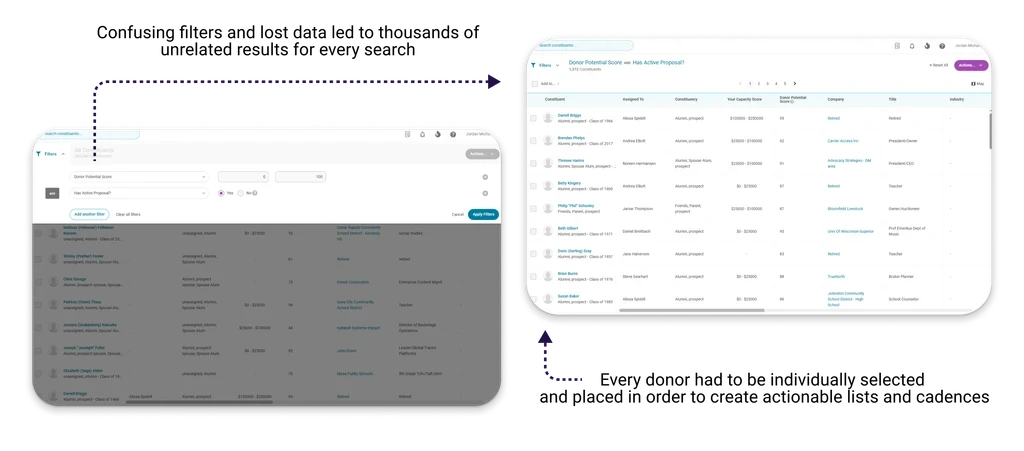
This made it difficult to confidently identify high-value donors, turning a core workflow into a slow, manual process.

Search was used ~26K times across platform per week, yet users still struggled to find relevant donors.

Pain Points

Search queries returned irrelevant or incomplete donor data

Search queries returned irrelevant or incomplete donor data

Multiple filters and iterations were required to surface results

Multiple filters and iterations were required to surface results

Donors had to be manually reviewed to build lists

Donors had to be manually reviewed to build lists

BUSINESS CONTEXT

Company Objectives & Goals

The team aligned on three key goals to guide the solution and ensure adoption within existing workflows.

Improve donor discovery accuracy:

Enable fundraisers to surface high-value donors from large, complex datasets

Enable fundraisers to surface high-value donors from large, complex datasets

Leverage AI to simplify workflows:

Replace manual filtering with an intuitive, intent-based search experience

Replace manual filtering with an intuitive, intent-based search experience

Drive adoption without complexity:

Introduce AI in a way that integrates into existing workflows

Introduce AI in a way that integrates into existing workflows

RESEARCH

Key insights from user research

Personas:

Donor experience and major gift officers who rely on search daily

Method:

Survey (n=41) + 4 stakeholder interviews

Insights:

26K / week

26K / week

The search feature was used ~26,400 times weekly, making it a critical workflow

The search feature was used ~26,400 times weekly, making it a critical workflow

70%

70%

of users had difficulty finding relevant donors using existing search

of users had difficulty finding relevant donors using existing search

90%

90%

of users were willing to adopt a new search approach if it improved speed

of users were willing to adopt a new search approach if it improved speed

65%

65%

of users were concerned about added complexity in their workflow

of users were concerned about added complexity in their workflow

IDEATION

Framing the solution space

We explored multiple approaches to reduce friction in donor discovery, evaluating each against speed, accuracy, and adoption risk.

Opportunity:

Enable users to surface high-value donors using natural language, without requiring complex filtering or manual iteration.
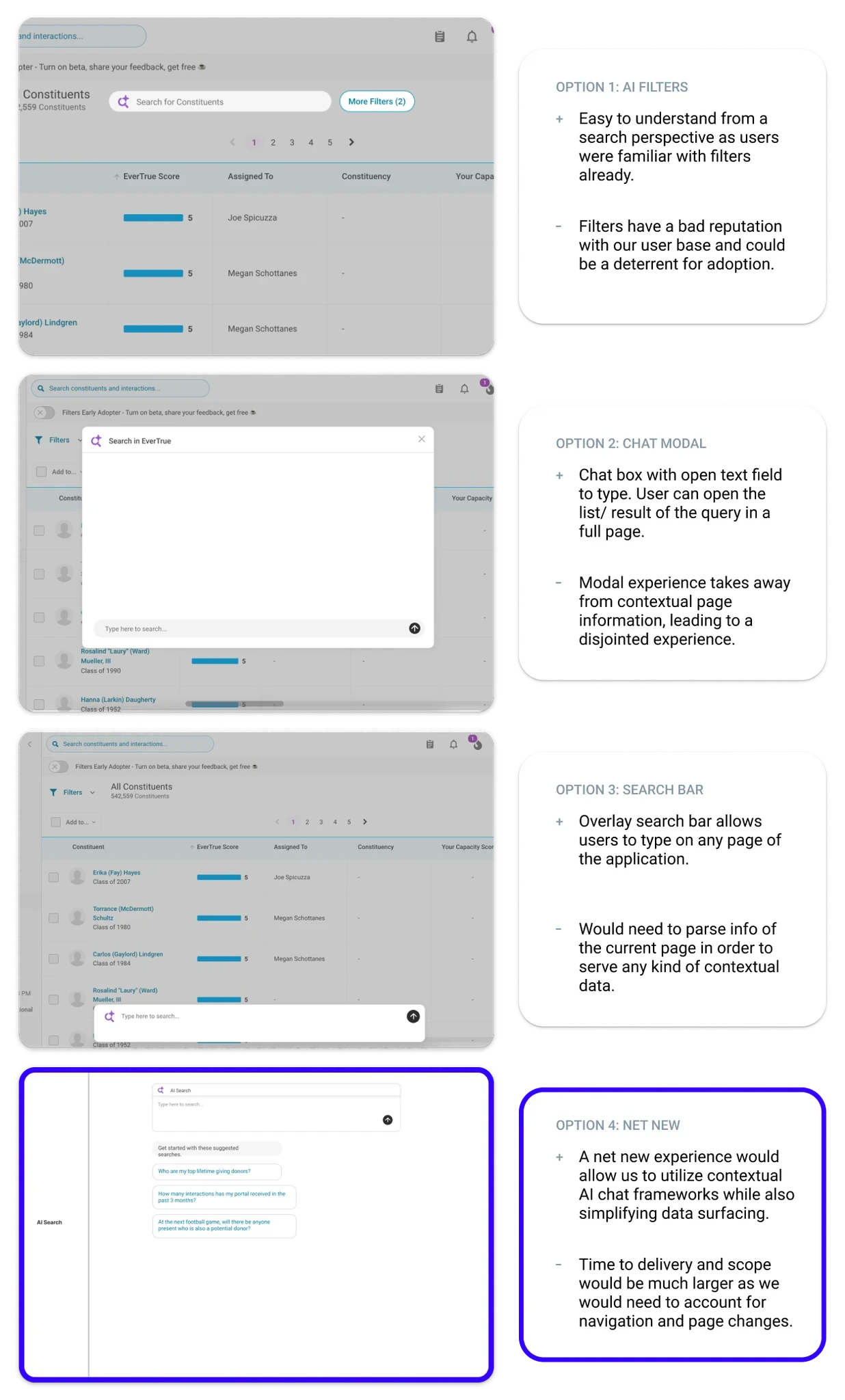
Selected direction: Net new experience

Lower-effort solutions improved parts of the workflow, but failed to address the core issues of accuracy, speed, and trust holistically.

A net new experience allowed us to:

Eliminate multi-step filtering → faster identification

Eliminate multi-step filtering → faster identification

Introduce contextual understanding → more accurate results

Introduce contextual understanding → more accurate results

Keep results in context → maintain user trust

Keep results in context → maintain user trust

This approach required significantly more scope and coordination, but created a scalable foundation for AI-driven workflows across the product.

VISUALIZING DATA

Designing the interaction model

A core challenge was surfacing AI-generated results in a way that felt fast, trustworthy, and easy to iterate on.

Search needed to function as a loop and not a single interaction, supporting ongoing querying, refinement, and action.

This model reframes search as a loop:
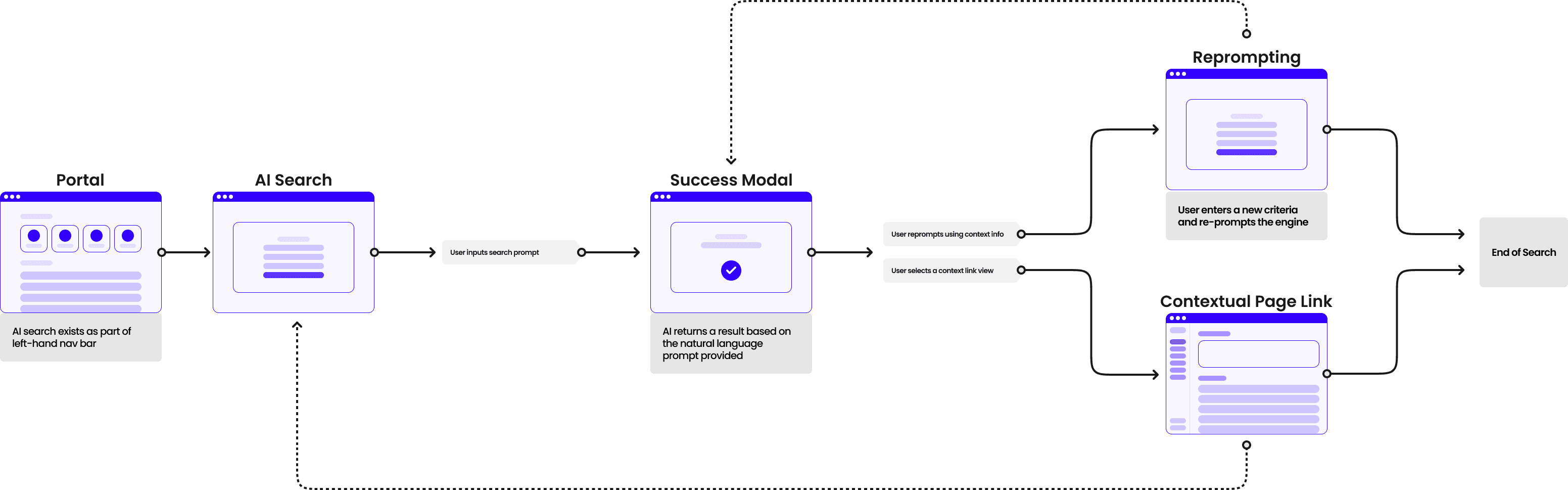
Input → AI interpretation → structured, actionable results

Input → AI interpretation → structured, actionable results

Users refine queries or transition directly into workflows

Users refine queries or transition directly into workflows

Results remain in context, avoiding modal or disconnected experiences

Results remain in context, avoiding modal or disconnected experiences

These decisions directly address the need for speed, accuracy, and low complexity identified in research.

Key design decisions:

Introduced a focused AI input to enable rapid re-prompting without overwhelming users

Introduced a focused AI input to enable rapid re-prompting without overwhelming users

Provided templated starting points to guide query formulation and reduce ambiguity

Provided templated starting points to guide query formulation and reduce ambiguity

Kept results anchored to existing workflows to preserve context and trust

Kept results anchored to existing workflows to preserve context and trust

FINAL EXPERIENCE

Primary interaction flow

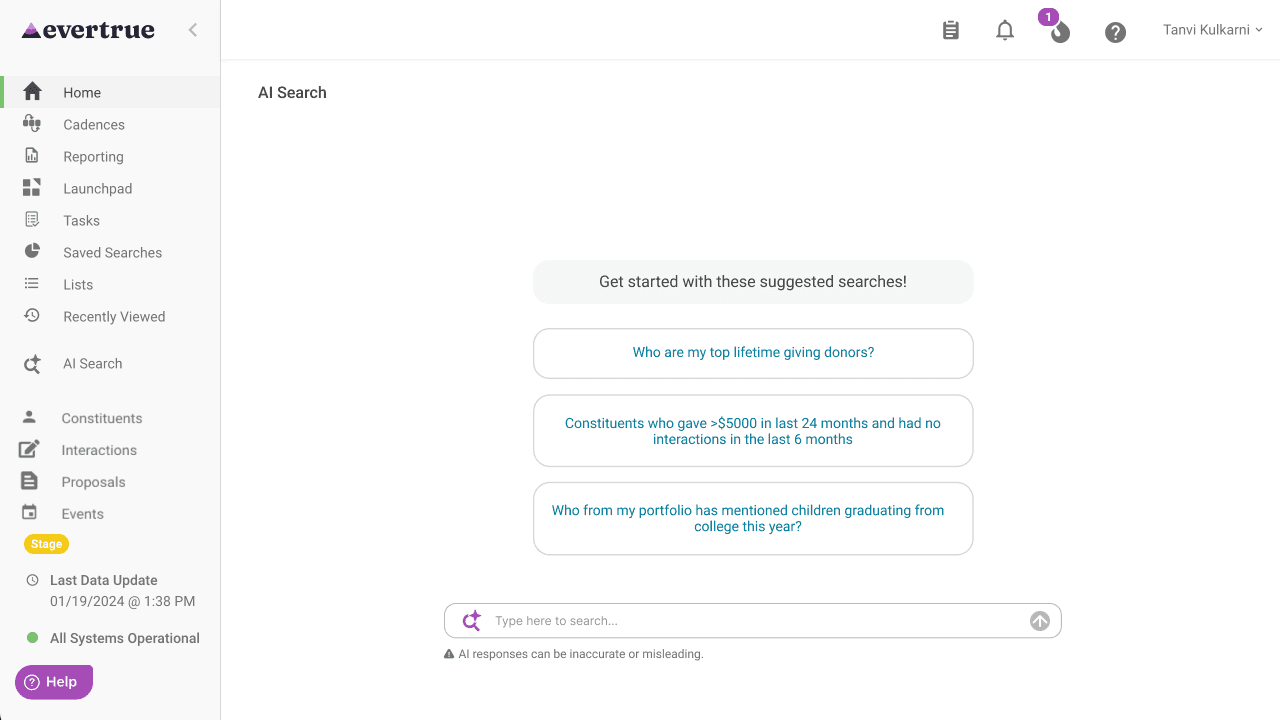
The final design introduces a faster, more intuitive way to identify and act on high-value donors through a continuous interaction loop.

This replaces fragmented filtering workflows with a single loop of input, response, and refinement.

1.

Query input

Reduces friction compared to multi-step filtering

Reduces friction compared to multi-step filtering

Encourages rapid iteration through lightweight input

Encourages rapid iteration through lightweight input

2.

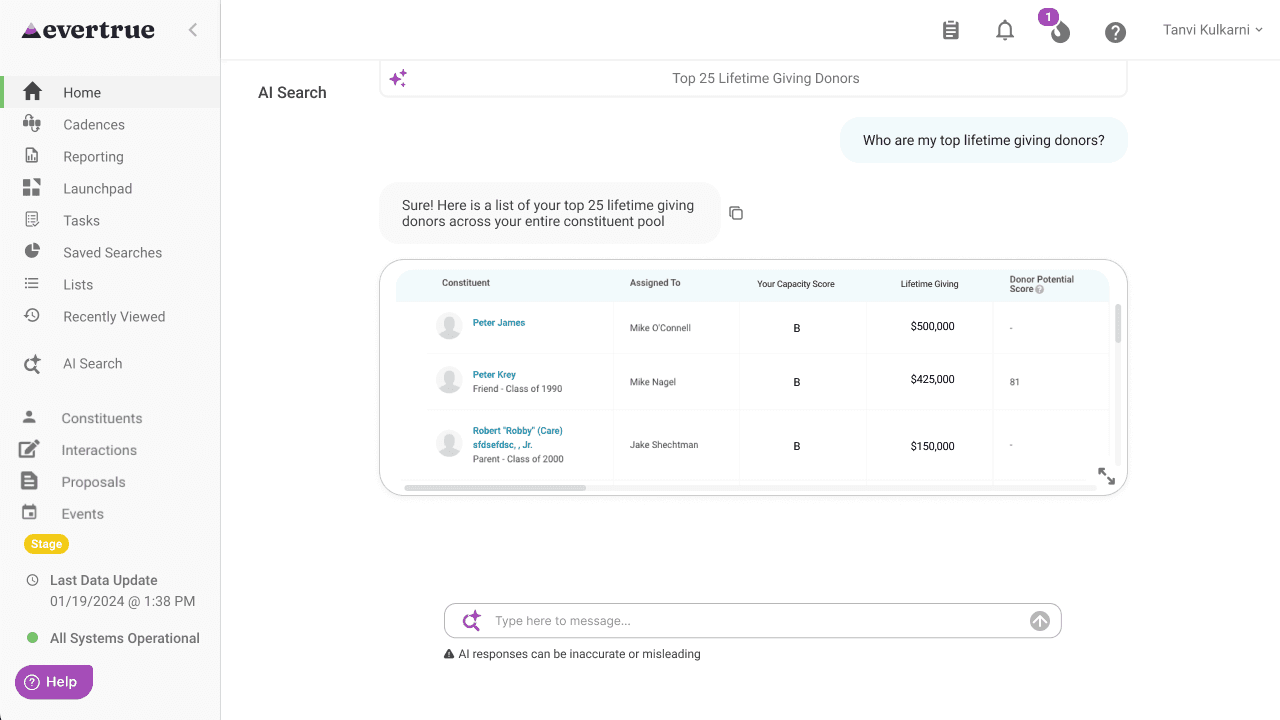
Result generation

Returns structured, scannable results instead of raw text

Returns structured, scannable results instead of raw text

Surfaces key attributes immediately for faster decision-making

Surfaces key attributes immediately for faster decision-making

3.

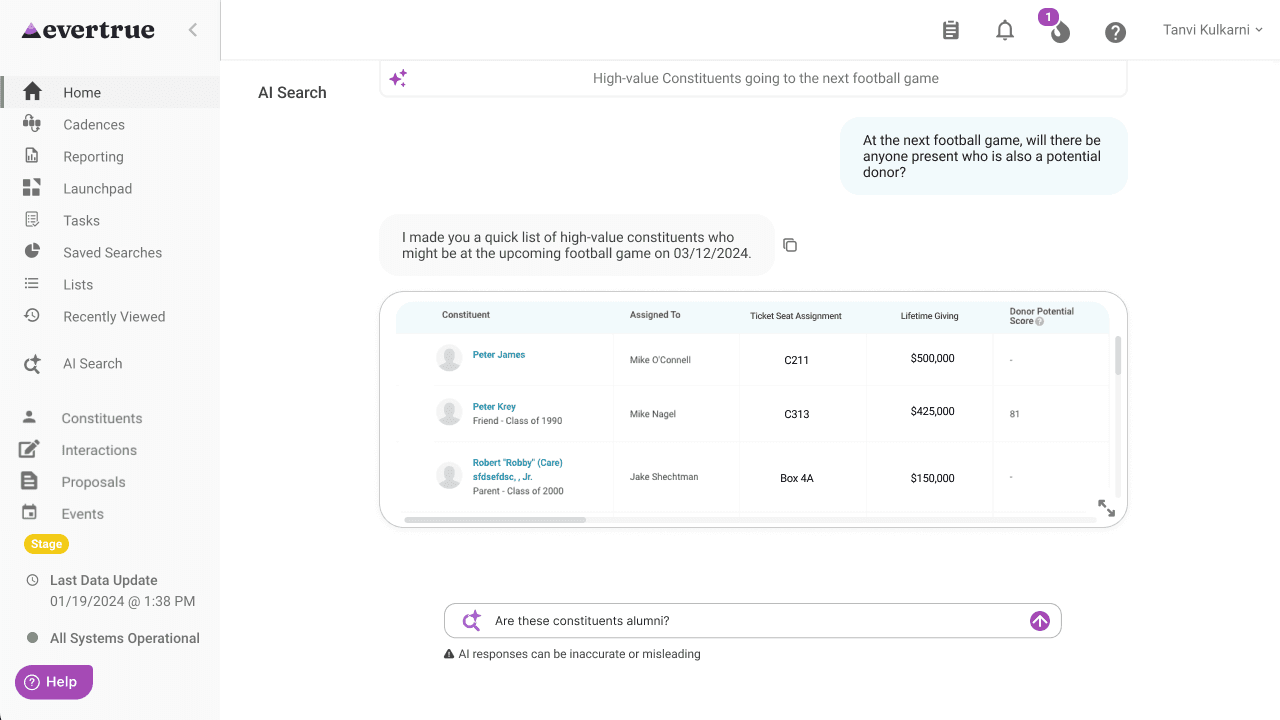
Refinement and action

Enables iterative refinement without restarting workflows

Enables iterative refinement without restarting workflows

Keeps users in context, preserving trust and continuity

Keeps users in context, preserving trust and continuity

Supports direct transition into downstream actions

Supports direct transition into downstream actions

Supporting states and variations

Templated Starting Points

Contextual Data Visualization
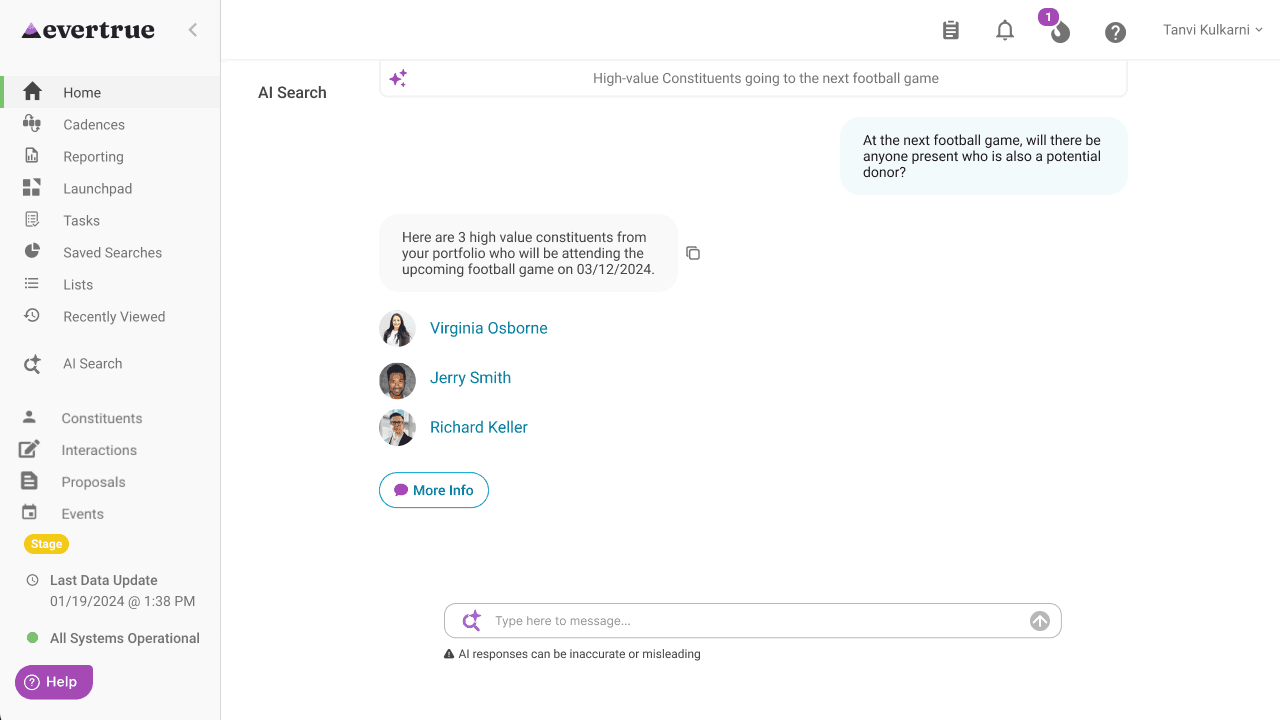
High-Value Donor Surfacing

Contextual Chat Logging

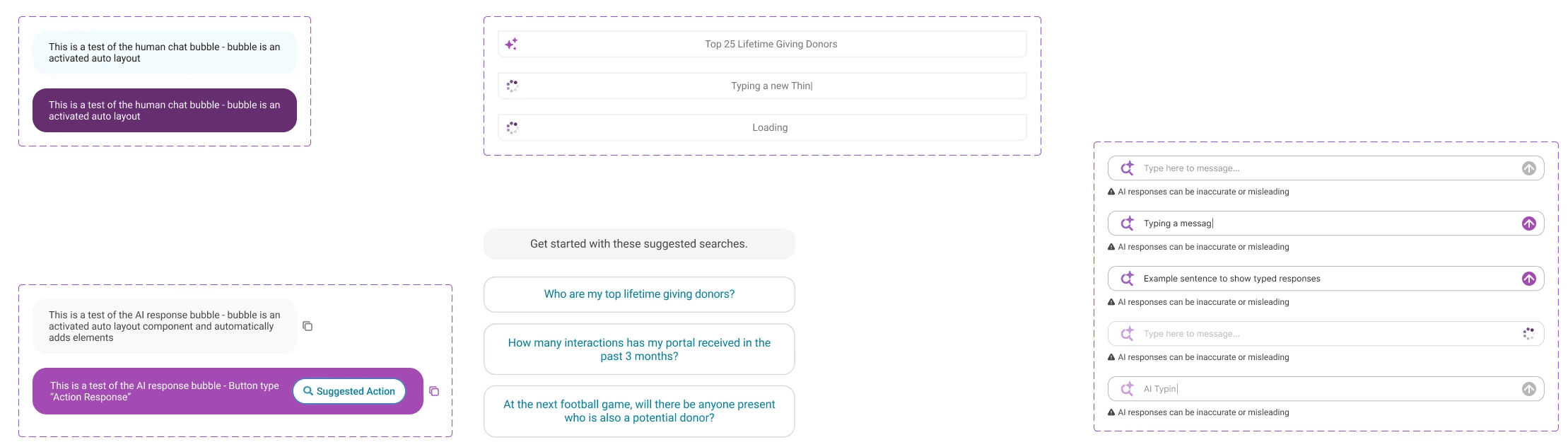
System-level components

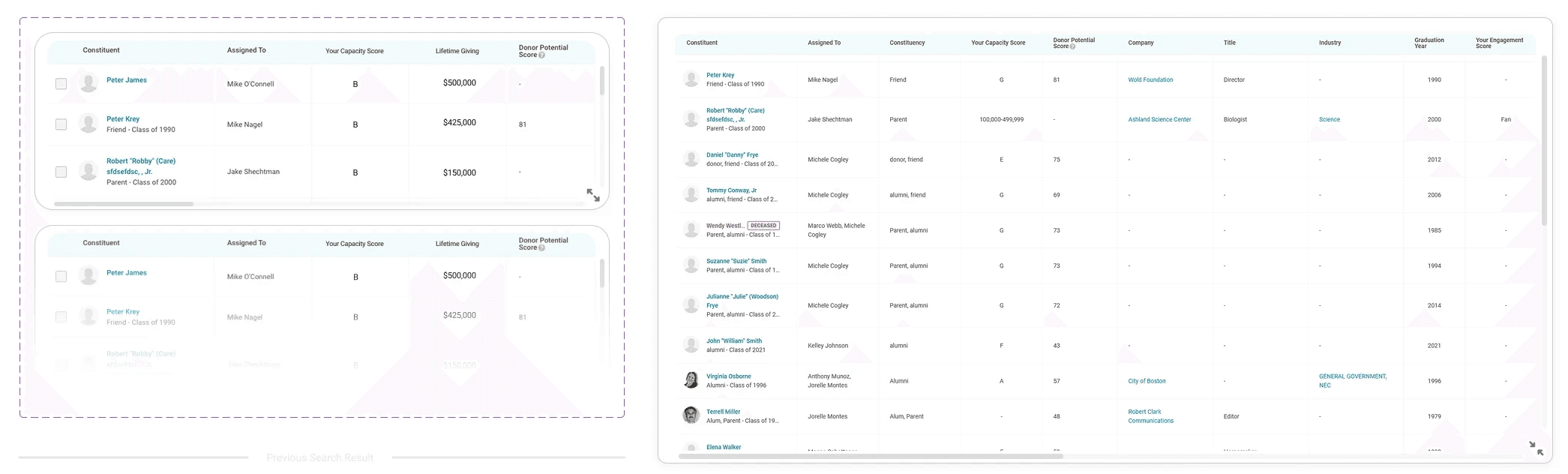
These components ensure consistency between AI-generated results and existing data structures within the product.
TAKEAWAY

Reflections

This work established a foundation for integrating AI into core product workflows, not as a feature, but as an interaction model.

Designing for AI required shifting from static interfaces to systems that support ongoing interaction and refinement.

A key takeaway was that accuracy alone is not enough. Users need results to feel interpretable and actionable within their existing workflows. Anchoring AI outputs in familiar structures proved critical to building trust and driving adoption.

This project also reinforced the importance of designing for iteration. Rather than treating search as a one-time action, framing it as a loop enabled more flexible and effective exploration of complex data.

Designing for AI required shifting from static interfaces to systems that support ongoing interaction and refinement.

A key takeaway was that accuracy alone is not enough. Users need results to feel interpretable and actionable within their existing workflows. Anchoring AI outputs in familiar structures proved critical to building trust and driving adoption.

This project also reinforced the importance of designing for iteration. Rather than treating search as a one-time action, framing it as a loop enabled more flexible and effective exploration of complex data.

This work established a foundation for integrating AI into core product workflows, not as a feature, but as an interaction model.

This work established a foundation for integrating AI into core product workflows, not as a feature, but as an interaction model.

Designing for AI required shifting from static interfaces to systems that support ongoing interaction and refinement.

A key takeaway was that accuracy alone is not enough. Users need results to feel interpretable and actionable within their existing workflows. Anchoring AI outputs in familiar structures proved critical to building trust and driving adoption.

This project also reinforced the importance of designing for iteration. Rather than treating search as a one-time action, framing it as a loop enabled more flexible and effective exploration of complex data.